Football's Sin Bin Works in the Grassroots and Terrified the Professional Game
TL;DR
Temporary dismissals — sin bins — have operated in English grassroots football since the 2019-20 season across dozens of leagues, using the yellow card to signal a ten-minute removal for dissent. IFAB moved toward wider trials, with a blue card proposed as the signal, and announced measures aimed at improving behaviour toward match officials. The blue card leaked a day before its planned announcement, drew immediate and heavy criticism, and was dropped. Sin bins remain a grassroots success and an unresolved question at elite level, where the earliest realistic entry into the Laws was pushed back.
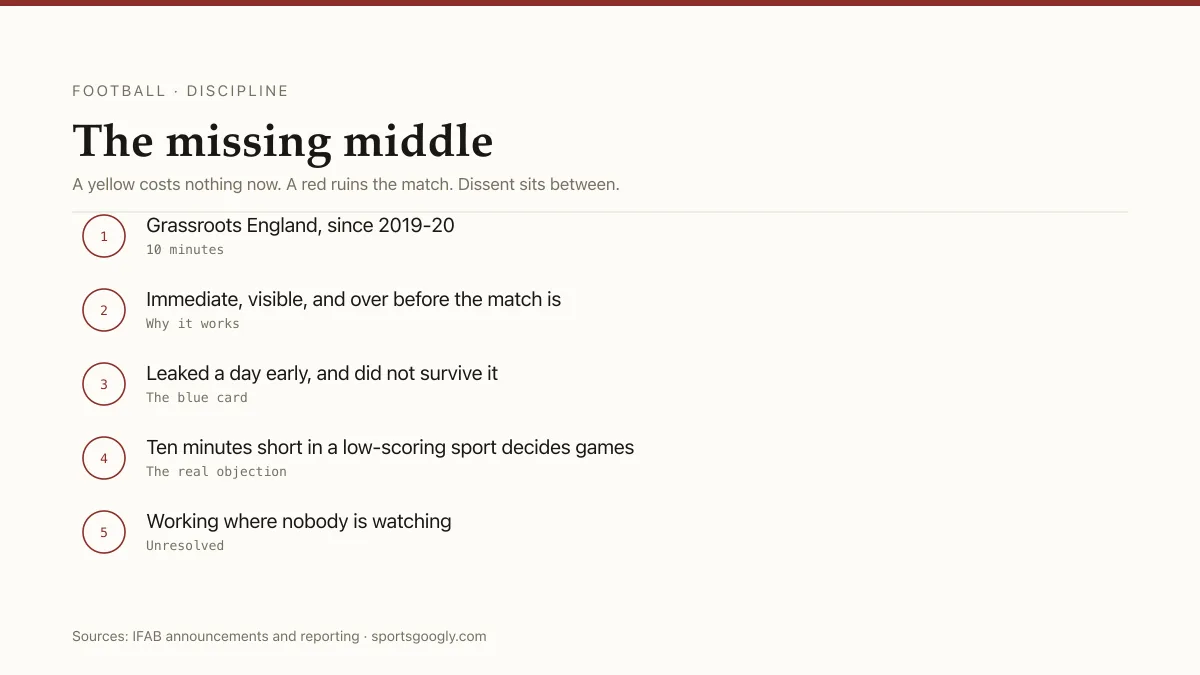
On this page5
The problem is that a yellow card costs nothing right now
Football’s disciplinary ladder has a gap in the middle.
A yellow card is a warning with a deferred cost: it matters if you collect enough of them, or if you commit a second offence later. In the moment, it changes nothing — the player stays on, the team is unaffected, and play resumes.
A red card is enormous: a player fewer for the rest of the match and usually a suspension after it.
Between “nothing happens now” and “the match is ruined” there is nothing. And dissent — arguing with the referee, surrounding officials — sits exactly in that gap: too common and too minor for a red, and entirely unaffected by a yellow.
A sin bin fills it. Ten minutes off the field is a real, immediate cost to the team, and it is over before the match is.
It already works, at scale
This is not a hypothesis. English grassroots football has used temporary dismissals since the 2019-20 season, across dozens of leagues, using the yellow card to signal a ten-minute removal for dissent.
The reported effect has been substantial, and the reason it works is that the punishment is instantaneous and visible. A player who argues is removed while their teammates play a man short and watch it happen. The social cost inside a team is doing as much work as the sporting one.
That is the same mechanism as rugby’s sin bin, where a ten-minute suspension has been part of the game long enough that players’ behaviour toward officials is noticeably different from football’s — a comparison football supporters make constantly and football’s authorities have been slow to act on.
Then the blue card leaked
IFAB moved toward wider trials, with a blue card as the signal for a temporary dismissal, alongside measures aimed at improving behaviour toward match officials.
The protocol was due to be announced. It leaked the day before, drew immediate and heavy criticism, and the blue card was dropped. Trials were restricted away from the very top level, and any entry into the Laws of the Game was pushed further out.
The objections were of two kinds, and they are worth separating.
Presentational: a third colour is confusing, football has managed with two for a century, and the name invited ridicule. This is not a serious argument against the underlying rule, but it is a serious argument about communication — and IFAB has learned before that a rule people cannot follow is a rule that erodes trust.
Substantive: a ten-minute absence in a low-scoring sport is worth far more than in a high-scoring one. In rugby, a team a player short for ten minutes concedes points and survives. In football, ten minutes with ten players against a good side can decide a match — so the sin bin is not a middle sanction at all, but something closer to a red card with a timer.
That second objection is the real one, and it has never been fully answered.
What is actually being weighed
The dispute is a straightforward trade between two things football says it wants.
Better behaviour toward officials. Referee abuse is driving people out of the game at every level, which is a genuine existential problem — you cannot run a sport without officials, and grassroots football is short of them.
Not letting a disciplinary sanction decide matches. Football’s outcomes are decided by very few events, and a punishment that produces a goal is a punishment out of proportion to dissent.
The grassroots evidence suggests the first is achievable. The professional game’s resistance is essentially a bet that the second cost is too high, in a sport where a single goal is worth what it is.
Where it stands
Sin bins remain in force at grassroots level, where they work, and unresolved at the top, where the trial timetable has slipped.
That is an uncomfortable but not indefensible position. The behaviour problem is most acute in grassroots football, where referees are volunteers and abuse is worst, and that is where the remedy is being applied.
The argument for extending it upward is about example: professional football sets the behavioural norm that filters down, and a rule enforced only where nobody is watching does not change what a fourteen-year-old copies on a Sunday morning.
For the other welfare rule football has adopted only halfway, see football’s concussion substitutes, and for the laws generally, soccer rules.
Frequently asked questions
Does football use sin bins?
Yes, in grassroots football in England since the 2019-20 season, across dozens of leagues.
How long is a sin bin?
Ten minutes.
What is it for?
Dissent toward match officials, and in the proposed elite trials, certain tactical offences.
What card is shown?
At grassroots level, the yellow card. A blue card was proposed for wider trials and dropped.
Why was the blue card abandoned?
It leaked before its announcement and drew immediate heavy criticism.
Could sin bins reach the Laws of the Game?
Not before further trials, and not at the very top level in the meantime.
Sources
Related
- Football's Concussion Substitute Is Permanent, Which Is the Problem
- The Offside Rule Explained: What IFAB's Law 11 Actually Says
- Football Tested a Fairer Penalty Shootout and Threw It Away for Being Confusing
- The 17 Laws of Soccer: The Complete Rules, and What Changed for 2026/27
- Baseball Rules: Everything That Changed, and When